Washington, DC— The Congressional Research Service (CRS)released a reportquestioning whether small businesses or consumers would see any benefit from the new government mandates in the Durbin-Marshall Credit Card Bill. Numerous reports have noted that when Congress imposed similar mandates on debit cards a decade ago, consumers did not see lower prices as a result.
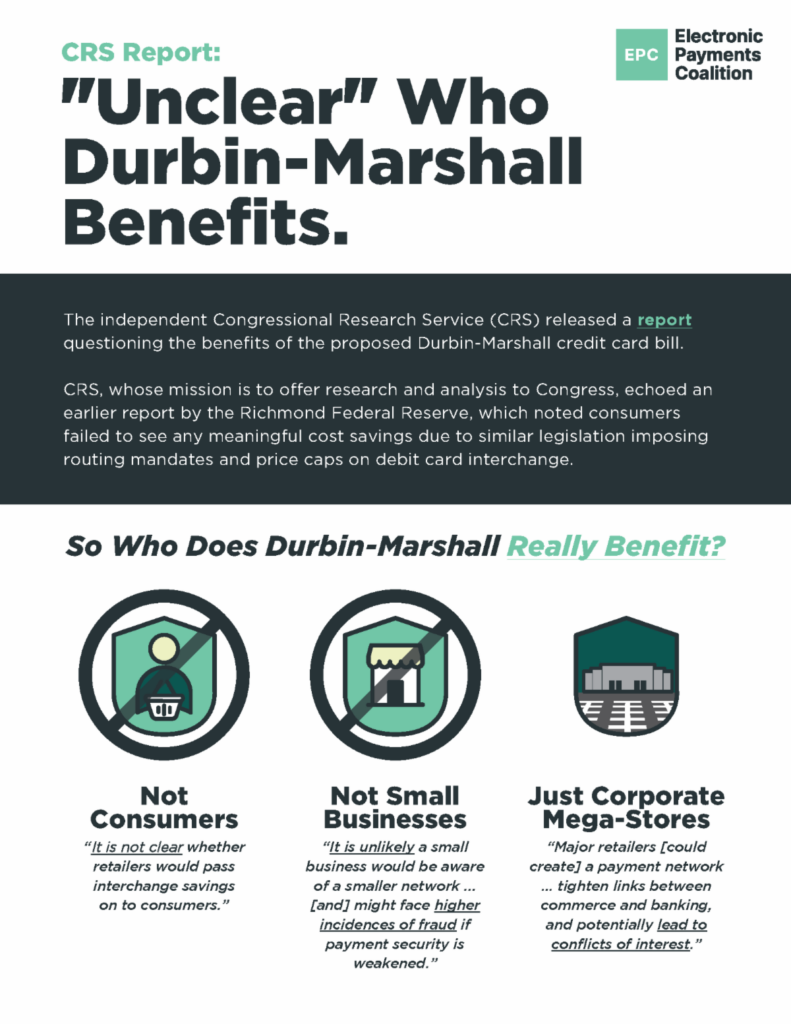
EPC’s one-pager, copied below, highlights how the CRS was unable to find enough evidence to support the claims being made by supporters of the Durbin-Marshall Credit Card Bill, including:
Unlikely Benefits for Small Businesses: “It is unlikely a small business would be aware of a smaller network, and even if it did offer payment on that network, the odds that a bank would issue a card enabled for that exact network are relatively small.”
Questionable Benefits for Consumers: “It is not clear whether retailers would pass interchange savings on to consumers.”
Increased Fraud: Businesses “might face higher incidences of fraud if payment security is weakened.”
Security Impacts: “If cards are effectively required to be interoperable, networks may be less willing to invest as much in secure payment technologies, as part of the benefit would accrue to their competitors.”
Potential for Corporate Mega-Stores to Mix Commerce and Banking: “There may be unintended consequences of this bill. For instance, there is nothing stopping the major retailers from creating a payment network … this would tighten links between commerce and banking and potentially lead to conflicts of interest.”
We are the credit unions, community banks, payment card networks, and institutions who support the backbone of our economic system: electronic payments.