
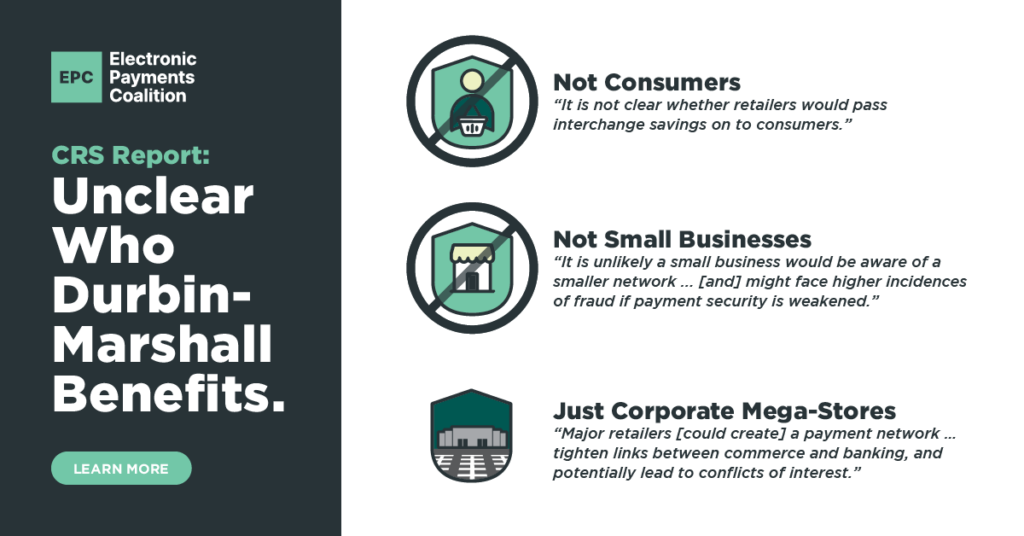
WASHINGTON, DC — Recently, the independent Congressional Research Service (CRS) released the latest in a string of reports questioning the benefits and raising the unintended consequences of the Durbin-Marshall credit card bill.
CRS, whose mission is to offer research and analysis to Congress, echoed an earlier report by the Richmond Federal Reserve noting that consumers failed to see any meaningful cost savings as a result of similar legislation imposing routing mandates and price caps on debit card interchange.
“The saying about insanity is doing the same thing over and over, expecting different results certainly applies here,” Electronic Payments Coalition Executive Chairman Richard Hunt said. “Report after report has plainly demonstrated that consumers and small businesses did not save any money when Congress imposed new mandates on debit cards. Now, a decade later, why would anyone assume a monumental restructuring of our nation’s secure, worry-free credit card system would yield different results? Every Senator and Representative should read the unintended consequences this legislation would have on our economy, small businesses, and American families. After doing so, the only logical solution would be to strongly oppose this massively flawed bill.”
In addition to noting “it is unclear who would benefit” from the legislation, CRS raised other points of consideration, including:
The full report is available here.